Physical Address
304 North Cardinal St.
Dorchester Center, MA 02124
Physical Address
304 North Cardinal St.
Dorchester Center, MA 02124
AaaS (Accuracy as a Service)
AaaS (Accuracy as a Service)
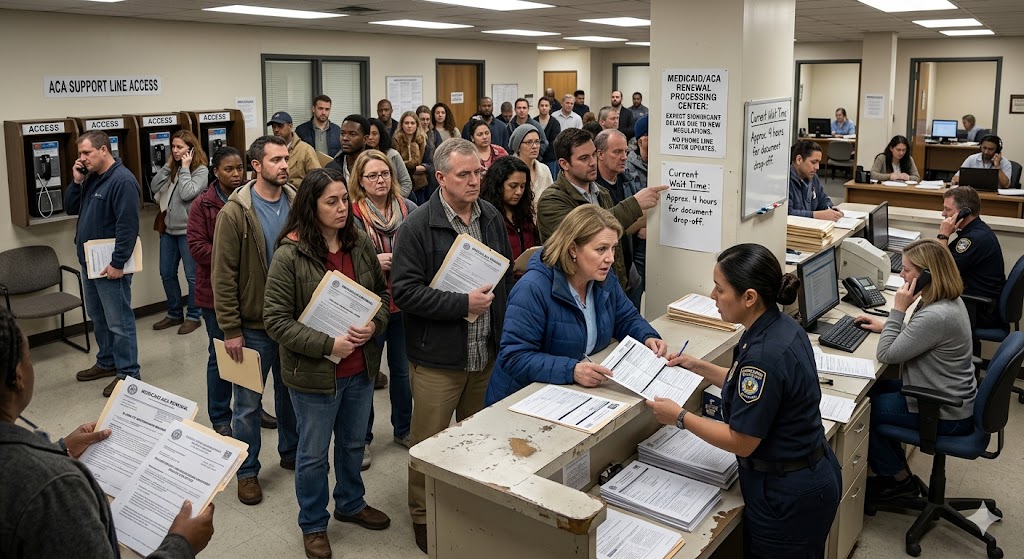
The American healthcare landscape is currently navigating a period of unprecedented administrative upheaval. While public attention has focused on the 12 million people losing Medicaid coverage due to the end of pandemic-era protections, a secondary, more insidious crisis is unfolding. Driven by the mandates of the “One Big Beautiful Bill” (OBBBA), state resources are being systematically stretched to a breaking point, creating a bottleneck that threatens the coverage of millions more who remain within the Affordable Care Act (ACA) system.
Across the country, federal agencies are mandating that all ACA and Medicaid coverages undergo aggressive reevaluations. Under the OBBBA, the standard 12-month eligibility redetermination cycle is being compressed to six months in several jurisdictions. This effectively doubles the administrative workload for state agencies that were already struggling with the initial “unwinding” of Medicaid.
The strain is not merely a byproduct of volume; it is a result of specific legislative incentives:
State resource centers are currently facing a deluge of inquiries from city and municipal agencies that are themselves unable to parse the shifting federal guidelines. This influx has created a renewal processing bottleneck where even simple, automated renewals are being flagged for manual review.
The pressure on the ACA Marketplace has shifted its mission from providing coverage to acting as a triage center for state agency overflow. Instead of addressing standard renewal issues, representatives are bogged down by a “confusing mash of legal maneuvering” stemming from a constant stream of Executive Orders that alter eligibility criteria weekly.
For the average citizen, the path to maintaining coverage has become a labyrinth. The OBBBA has effectively ended year-round open enrollment for those with incomes below 150% of the federal poverty level. Now, missing a single administrative deadline or failing to provide an immediate addendum to a filing can result in an outright drop from the rolls.
These measures are not accidental; they are part of a broader strategy, acknowledged in the Senate and Congress, to reduce federal spending by increasing the “churn” of enrollees. By creating a chaotic environment where laws change daily and official documents become obsolete before they are even processed, the system is disenfranchising millions—leaving them with no clear path to appeal or reapply.
As state agencies struggle to stay afloat, the reality of the “Big Beautiful Bill” is becoming clear: it is a high-pressure administrative squeeze designed to reduce the healthcare roles through technicality and exhaustion.
While the United States has drifted far from the era of its founding, constitutional historians largely agree on one fundamental point: the Founding Fathers viewed pure democracies as suspect. This is not the opinion of this publication—in fact, we believe the exact opposite. True democracies are our only hope for planetary survival. However, to understand the current crisis, we must layout how these “shadow legislations” work against society, with the ACA serving as a perfect example.
The Founders believed democracy could only function if controlled by a group of elite property owners who would decide which laws were written and which were suppressed. This philosophy formed the bedrock of our three-tiered government, designed to elect the most “qualified” elites. It is why, even today, a Harvard graduate often sounds more like a “senator” to the public than a candidate from a local State University. To maintain this, a vast bureaucracy was built—a pyramid of bodies where the number of people at each level diminishes as the “elite” status of that level rises.
The problem with this system is that the elites who founded it desired to maintain the wealth and privilege of their station—something that cannot happen in a true democracy. To preserve their positions, they created a system of tiered privilege. Each descending group in the hierarchy has less power, ensuring that those at the very top can focus on maintaining their own group’s power rather than a common goal for the whole of society. This process is mirrored throughout history; to study it is to study the “Warlord State.” It is how authoritarians consistently gain power through what appear to be normal democratic processes.
Every society fits into this rigid structure:
This system puts enormous pressure on the social fabric. It is inherently unstable and collapses regularly. When it fails, the elites spend their time “fixing” the oppressive structures just enough to allow authoritarian propaganda to look functional again. But history shows that no state built on this bureaucratic elitism survives—not Rome, not Egypt, and eventually, not the UK or the US. A bureaucratic system is merely another form of dictatorship, and it can only be stopped by forcing the structure to accept everyone equally, regardless of their particular abilities.
The present system rewards the elite for simply being elite. To prevent any movement that might restrict their power, they implement laws—the “Rule of Law”—that they demand everyone else follow, while they themselves remain above reproach. They maintain this order by demonizing groups: the young, victims of violence, and the homeless. Institutions educate the public to respect the elite, claiming they must be held above the law to prevent society from falling apart. An actual democracy would end this practice and likely result in an even stronger, fairer Rule of Law.
In our current society, the unwritten rule is: “Don’t make waves; stay in the place chosen for you.” But that rule has never worked for People of Color, women, or victims of war. When the public begins to realize this, shadow legislation is enacted to maintain the necessary pressure.
The “One Big Beautiful Bill” (OBBBA) is the major pressure point currently publicized, but it is only the beginning. In the shadows are constant, unenforced changes that affect millions indirectly. While the media covers the major political affronts, the quiet assault by Congress, the Senate, and the Justice System goes unnoticed.
The struggle of the daily hardship we face—the supposed “supply chain problems,” “housing issues,” or “food shortages”—are not natural phenomena. They are pricing and resource decisions made by people with the power to decide how you must live to maintain their standing. The bureaucracy wants you in the struggle because the struggle is what the bureaucracy was designed to handle. It is the legacy of men who were, above all else, afraid of the people ruling themselves.
A significant chapter of United States history belongs to the media and journalism—the “Fourth Estate” that has often unmasked the intricate plots designed to control the masses. However, today, bureaucratic “red tape” serves as a fortress, preventing the actual resolution of problems facing the population. We have engineered a society that prioritizes treating symptoms rather than curing the cause. If you are drowning in debt, the system offers a loan; if you need information that was once free, it offers a premium subscription; if you are sick, it offers a treatment rather than a cure.
These mechanisms ensure that small, elite groups maintain oversight over a general population that recognizes it is being controlled but feels powerless to act.
The final “shadow” in this structure is the intelligence apparatus. These entities maintain the systems ensuring that global resources flow toward the American elite, creating a powerful insulating structure protected from public scrutiny. They stabilize—or destabilize—foreign nations to maintain the core structures of a Constitution originally designed to protect the privileged while offering just enough freedom to enlist the public in maintaining that privilege. This has culminated in a level of systemic corruption and crime that is unprecedented in our history.
We have maintained this hierarchy for centuries; it is now our job to transform it while keeping society functional.
A true democracy would recognize the most basic premise of Artificial Intelligence: the preservation of life. This was the core policy addressed by this publication at the 22nd International Conference on Technology, Knowledge, and Society. Currently, no institutional bylaw, legislation, or technological construct states our core function simply: the preservation of all living things—our planet, our people, and our animals. This essential requirement cannot exist in a society built on the maintenance of elite power.
We can still have wealth in the form of universal prosperity; we can have a strong Rule of Law built on reasonable justice. However, this requires independent committees and checks that exist outside of self-regulation. While authoritarian-leaning economies like Russia, China, and India risk failure by tightening their grip to feed their elites, the United States has an opportunity to choose a different course—one where we regulate extreme wealth and power for the good of the whole.
Our publication is dedicated to being the voice of those who must be recognized as viable participants in our laws and systems of power. Working alongside the Artificial Intelligence Basis Foundation, we have been invited to speak at core policy-making conferences to advocate for these shifts in global structure.
To support our mission and help us reach these critical platforms, consider subscribing to our Substack for $8.00 per month or making a donation. If you believe in a true democracy—not just a republic or a social society, but a democracy spread far and wide—help us fight for it. Your support allows us to bring this vision to the halls of power for just a few dollars a month.
Substack Article