Physical Address
304 North Cardinal St.
Dorchester Center, MA 02124
Physical Address
304 North Cardinal St.
Dorchester Center, MA 02124
AaaS (Accuracy as a Service)
AaaS (Accuracy as a Service)
What would you like it to be, Wall Street or Main Street, play the video and decide.
Exclusive Comp-ed Edition | Limited Time Access
The current trajectory of Artificial Intelligence (AI) in global finance is not merely a technological evolution; it is a structural redesign of the barrier between capital and labor. While AI is often marketed as a “democratizing” force, its integration into the stock market and corporate governance is creating a “pithy arrogance”—a system that makes high-stakes decisions based on algorithmic patterns while lacking the “on-the-ground” expertise of the workers who generate the actual value.
As AI-driven high-frequency trading and autonomous corporate agents take over, we are witnessing the birth of “Unregulatable Capital.” Mega-companies are moving into a space where their decision-making processes are “black boxes,” shielded from government oversight by the sheer complexity of their code.
While the average American is alienated from the housing market, the entities providing “managed living” and “new construction” have seen historic gains. Since 2019, home prices have surged by approximately 53%, while median household income has only risen by 24%.
| Sector / Company Type | 2023 Profit Gain | 2024 Profit Gain | 2025 (Projected) | Notes |
| Institutional Landlords (e.g., Invitation Homes) | +12.4% | +9.8% | +11.2% | Driven by “Rent Growth” stabilization. |
| Major Home Builders (e.g., D.R. Horton, Lennar) | +18.6% | +14.2% | +13.5% | Shift toward smaller, high-margin builds. |
| Multifamily Management Cos | +8.2% | +7.5% | +8.9% | Increased “Concessions” but higher base rents. |
Real Estate Association Fact: National home prices have increased by +53% since 2019, effectively locking out first-time buyers who fuel the “Economic Flow.”
The cost of living crisis is most visible at the dinner table. Food costs have risen dramatically, yet the distribution giants and massive corporate landowners have seen their margins expand rather than contract.
| Company / Sector | Profit Gain vs. 2019 | Market Dominance |
| Sysco Corporation | +24.5% | Broadline leader in food service. |
| US Foods Inc. | +19.2% | Major retail-focused distribution. |
| Bayer (Agri/Seeds) | -80.0% (Share Price) | Anomaly: Profitability hit by litigation despite 23% seed market share. |
| Corteva (Agri/Seeds) | +42.0% (Sales) | Heavy AI integration in “biologicals.” |
| Syngenta | +31.0% (Sales) | Partnerships in AI for “plant DNA.” |
Cumulative Food Price Increase (National Avg): +28% to +35% across major categories since 2019.
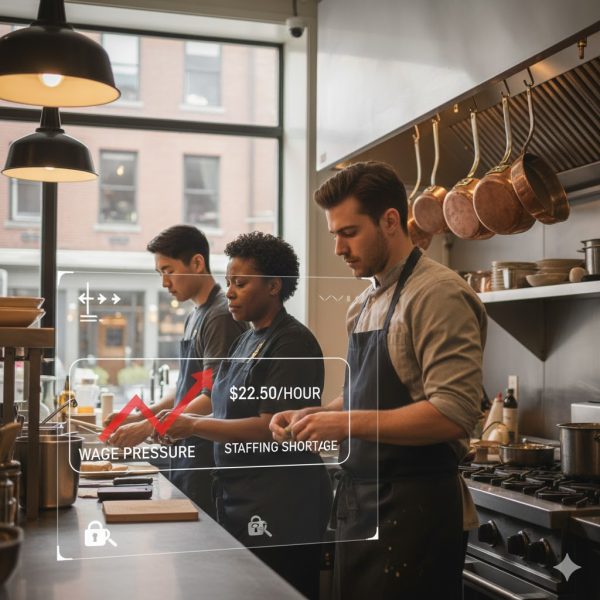
Traditional market indexes ignore the “Hidden Labor Gap.” To understand the true health of the United States, we must look at the Real Labor Participation Rate, not just the “Unemployment Rate.”
Since 2001, nominal wages have risen by over 86%, but when adjusted for the cost of living (Real Wages), the growth is a staggering 14.2% total over 25 years.
The Human-AI Co-Op views these data points not as inevitable trends, but as a call to action.
Tuesday Teaser Reminder: This deep dive is a preview of our Market Pulse intelligence. Your complimentary access will revert to a free-tier subscription soon To maintain your seat at the table and access our full 14-sector analysis, subscribe now for $8.00/month or $80.00/year.